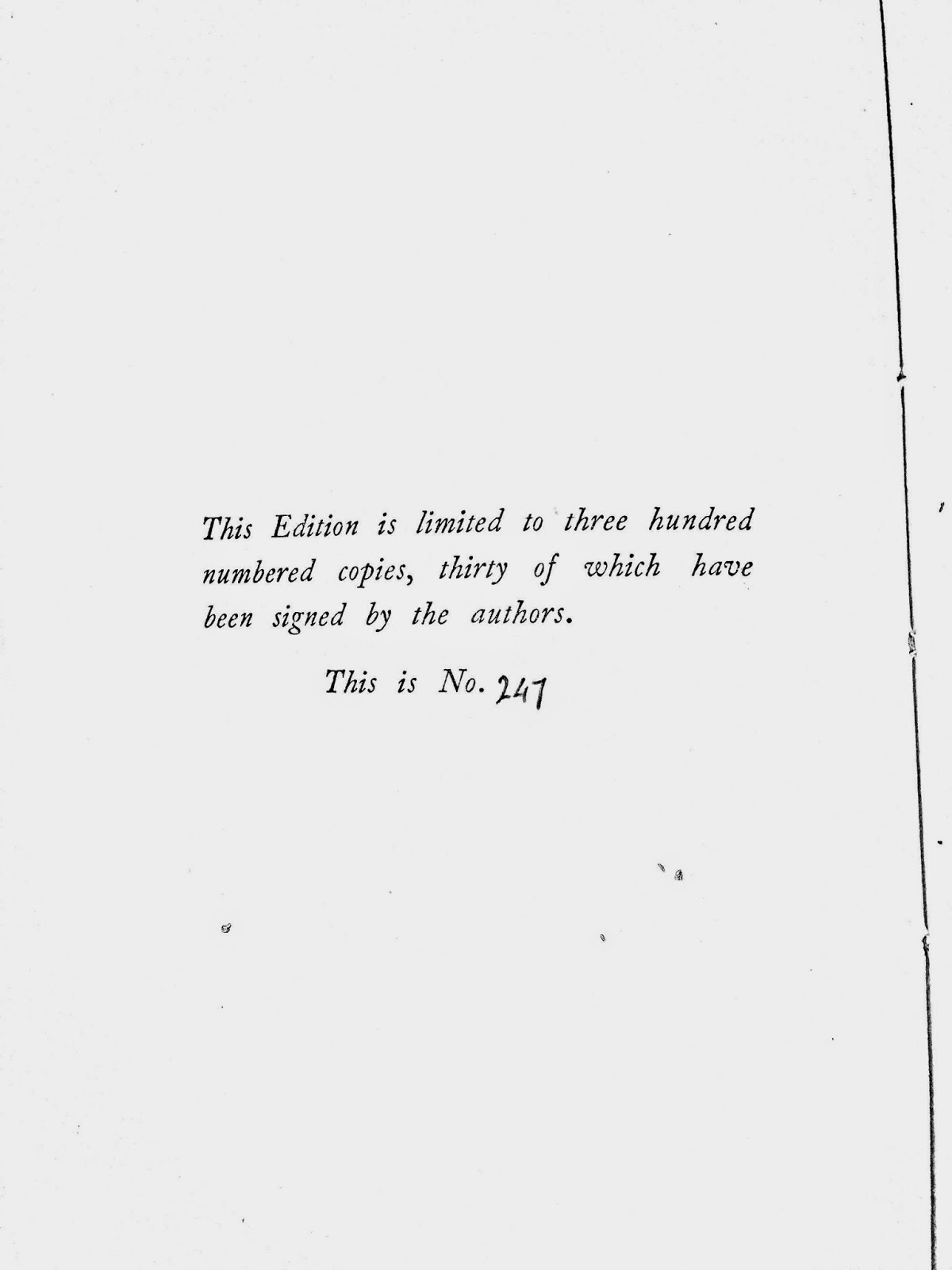
| No. 247 is reproduced and digitized here for scholarly purposes. Use images in accordance with the authors' 1934 lapsed copyright. |
Monday, 26 January 2015
TWENTY POEMS by Niall Sheridan & Donagh MacDonagh (1934; 2015)
Friday, 16 January 2015
JANUARY POETRY
This is a sentence.
Lindsay O’Connell
your compliments arrive at a
well-considered welcome moment and, though not decidedly deserved, are
appreciated by me because writing, as you no doubt know and have tried to convince
me so far, takes lots and lots and lots of practice, and so I encourage the unfortunate stroke to break rules and
elide convention which you make (if only in your own mind) through humour,
as well as the other means at your disposal: sincerity, save-face, pity,
pouring drinks etc., along with your appeal to me here; but the vastness of this
appreciation, my appreciation for your writing that is, which is ever-widening
I assure you, reminds me that I, and almost certainly any other person who aims
to practice (like breathing), never set down rules and only aim to suggest
(often through example) the best way to approach cuneiform which will always be concerned with the picture, or the
problem, or the person, or the task it traces; however, these
reasons, while admittedly strong in counter-point, do not change the outcome of
today’s meeting – an event that seemed to me to be more about the relaying or
rules and stylistic necessity of texting
than encouragement to keep on writing – move your pen, move your pen, shift-up,
shift-up, it’s a call to write write
write…
Sunday, 16 November 2014
NOVEMBER POETRY
Three Ways of Not Saying Something
André Narbonne
1. You're
missing quite the river. It's working out its cricks -- stretching in the sun.
I walked by
on my way home from downtown.
I thought
something large was passing, but it was just the expansiveness of it all,
popping.
Anyway,
that's what you're missing. I thought you should know that.
2. Here's
what you're missing today:
The river is
changed. I walked by it, laden with problems, on my way from the LCBO, and it
was voiceless. Today is warmer but the sunlight is a vague patchwork that
doesn't heat. It's not the same verb.
Yesterday
when I pulled myself up from other things I expected to see a freighter and was
surprised to find, instead, three white swans staring back at me. Imagine:
three swans – the magic number of the trinity and other narrative functions. I
felt cheated by the mythological implications. I felt like I wasn't viewing
anything in particular, like discovering that the meal I was eating had been
eaten before by so many other people it could no longer be said to have a
flavour. That's what I thought, but, happily when I looked further I found two
other swans. So five. I thought, that's good and irregular. When I looked for
more I realized that the narrow bits of open water (imagine cracks in a window
with some of the knife-like pieces missing) were overpopulated with birds, but
they were darker than the swans and had to be understood differently, had to be
made visible through some sleight of realization.
Today I
didn't see a single bird. I didn't hear a gasp or a pop. No voice, no life. If
you look near the shore you'll see the ice is piled up in flat sheets the
scattered way discarded paper sometimes lies beside a printer when something
difficult is due. It frames the centre of the river, which is mostly open.
Yesterday's voice seems to have smashed a channel of broken knife blades.
But you'll
see all that when you come back. Maybe you'll have birds. How strange they
should be there on a day when the river was so loud.
3. The first
time I saw the river
it was
summer and a man was
selling
French fries from a
truck and
that was comedy and
the other
trucks on the bridge
were
gravitas and
the river
was the sort of idiot
you can
never master and
the clouds
were steel
traps
clamping a church
in their uninspired
significance.
The day felt
like a carnival of nothing.
How could it
change?
It didn’t
change.
The first
time I saw the river I didn’t
know what I
was looking at.
NOVEMBER POETRY
Our mother had
the wrong kind of children
Ellie Hastings
Enough happened
to peel delicacy
from our palms
not yet wide enough
to have our fortune told.
On days we could not stand
tall enough
to reach up,
crossed fingers could not save us.
Cleanliness was holy
water. Cleanliness was sharing a bath.
But like children cement themselves
in sidewalks
and skinned knees are still
on driveways,
we’re buckled in.
Our own fortune happened
enough.
NOVEMBER POETRY
Quentin
By Christopher McCarthy
•
There he is
on a bicycle.
Bad timing
up my nose.
Through walls
he and his
wife fought
long – hard.
Still, looks
shatter with
a grin / a firm
handshake.
She says she’ll
kill
herself but
don’t believe it.
He’s Hughes of the
Fox not fingernails.
Tuesday, 3 June 2014
"scaling letters" an a/g review
scaling letters:
rob mclennan and How the alphabet was made
by Aaron Daigle
rob
mclennan's How the alphabet was made, subtitled [an instructional]. What
this 2014 chapbook instructs might be the characterization of the alphabet.
Getting ahold of slippery letters seems a recent poetic preoccupation in
Canada: Christian Bok's eunoia formally constricted himself to one vowel
in each word, rob suggests a concept behind each letter and uses that as the
limitation.
The
chapbook is unassuming in appearance, but the cover hints at the project. The
first fifteen letters of the alphabet are bubbled with a corresponding
hieroglyphic, alluding to a time where letters were not abstracted from
concepts. Though there are fifteen poems in the book, they do not correspond to
the letters on the cover.
"A"
is "shocked, an appetite." We say "a" when surprised or
opening mouths.
"B"
is "bewitching," sexual.
"C"
is musical, "Below middle" C, and describes how music blurs
distinctions, "conflate"s.
"F#"
is "A failing, flustered," struggling.
"G-d"
is spiritual.
"Hh"
is "connecting, land-bridge."
"M"
is "miracles."
"N/A."
"O"
is "A flower, two out of this grief."
"Ph"
is a doctor, "Chemicals and the subsequent mouth."
"r"
is for regret.
"U"
is displaced, "Snowfall: we need less / a person,"
"V"
is "The basic mysteries adrift,
/ a shrapnel feeling."
"xxx,"
is the "basic mystery" of sex: "Such Hubble shapes in
crinoline; vernacular / ethics, tiny / bubbles, baubles. Take it / all off."
Where "Outside: / is very, very bright."
"Zed"
is Canadian, "The Story of a mailman, shallow bed of bone / and whispers."
Some
stylisms cohere the chapbook. mclennan uses commas and semicolons to disrupt
full sentences. As he isolates the character of each letter, he suggests a
unifying link to this letter may be found in disparate words, something that
resists linear narrative: "Sidebar, notion; plants and seeds and trees
from earth, a suspect, carnage; a suspect vehicle, / what you would wonder:
we / were not an end. / Pegasus, thy lusty Minotaur; some alphabets
believe" ("A"). These italics provide a second level of text,
the equivalent of theatrical asides and parentheses.
The poetry
leaves gaps in syntax just as much as the page, space for the imagination to
fill. "An impure whiteness, shark" ("Ph"). By arresting
normal conventions of thought with a firm grounding in the senses, the body
responds to these poems on an intuitive level, shaking a reader from
complacency. Not least of which when the reader themselves is urged to
"Name, me out of mourning, back into display. Top of the stairs"
("r").
Most
effectively, mclennan's keen observation eye leads him to startling assertions
about the nature of reality. These types of sentences disrupt logical sequences
while concisely starting a powerful metaphor. For example, "This wooded
moment, perished like an owl" and "Horizon frames us, just as much /
the television; composed of fragments; throttled-ground, // a quell between the
bones" ("Hh"), "We, who are wondrously large / present no
difficulty to an empty room" ("A"), and "What the dog
knows." ("V"). Much of mclennan's poetry juxtaposes the large
and the sall, the individual and the environment. The value of a strong
metaphor or image cannot be understated.
mclennan
suggests that our conceptions of language are constantly shaped and infused by
what we perceive. It's easier to sense and feel the presence of a letter when a
title points to it. By virtue of being connected in that poem, the poet asks
the letter's function: what is particularly "B" about "Bestial
everywhere, a blade of synapse, / blazing; we ride a long time on the
subway." By simply titling each poem after a particular letter, instances
of that letter on the page are bolded in the imagination.
I hope mclennan
expands or revisits this project. Nine letters remain to be told of the
alphabet. There weren't any major criticisms I had of the chapbook. I'm divided
on mclennan's habit of beginning a line with a comma – it maintains the
aesthetic ambiguity of ending a line without punctuation while clarifying the
grammar in the sentence. Beyond that, "These eyes, yes, a thousand"
("G-d") thoroughly enjoyed the chapbook. How the alphabet was made?
Perhaps through a mind to observe, concepts to describe, and a world to
realize.
Tuesday, 8 April 2014
Review of an October Performance of M. NourbeSe Phillip’s 'Zong!'
Missing The Boat: Zong! Reading[s] & Performance in 2013
Joseph LaBine
After viewing Julian Alystyre’s
video “NourbeSe at Naropa-Wake for Trayvon Martin”[1]
and participating in a group reading at the University of Windsor this October,
I think it is necessary to highlight the differences between conventional, one
person readings of Zong!, by Philip
herself or individual readers, and
collaborative performances, like the two I’ve just mentioned. Something occurs
during the performance of the text—something—that
is phenomenological. It disrupts the usual encounter of reading because the
experience of reading is fundamentally altered when the text is read in a
group. By performing Zong!, I believe readers
move past abjection in the text and transcend the horror of the historical
narrative intertwined with the poetic.
Recently, I have seen several
articles attempting to describe the effect felt at collaborative public readings
of Zong[s], or responding to performances of Zong!—performances both watched and/or engaged in. Of note, are
Susan Holbrook’s “M. NourbeSe Phillip’s unreceoverable subjects,” an essay
which responds to a performance by Phillip only and Janet Neigh’s “Dialogues
with M. NourbeSe Philip,” which describes a group reading. For the singular
reading Holbrook suggests the reader is unable to transcend the horror of the
historical account delivered in the poems—the murders that occurred on the
slaveship “Zong”— the performance does not end with “joy and relief”; the
slaves are drowned, their voices reduced to silence, “the story can never fully
emerge” (Holbrook par. 1). I was inclined to agree until witnessing the
phenomenon of a collective group reading of the work. Neigh describes an
experience similar to mine:
Handing out about
twenty photocopies of Zong!, [NourbeSe] provided the audience with page numbers
and instructed us to read these pages along with her without worrying about
staying in unison. A mesmerizing cacophony ensued, as voices moved under, over,
and around each other. (Neigh par. 1)
So
far, no one (to my knowledge) has conducted a study of these performances and
theorized how they might change meaning within the text. This is my main
concern, because Zong! is a work that
requires multiple reading strategies, multiple interpretations of
voices/languages/words/silences, it seems apt that performance-reading is one
of the methods we consider critically. I am particularly interested in how oral
and aural aspects of the text—the zongs heard and spoken at a reading—change
our interpretation of the poems on the page. I am focussed on a certain
mnemonic function that interrupts syntax and how we read the text internally,
thus changing meaning—reversing our memory of the narrative as we hear and
re-hear the poems verbally. I am not the only person to read the text in this
way, Jasper Appler has argued in “ZONG! a Narrative Told Without Telling” that performance is the life of the text,
“narrative relies on the oral and aural for animation…even in a private reading
the text takes life only once you speak it” (1). This is true. The verbal
phenomenology of Zong! interrupts how
we receive the meaning of the text internally. Phillip’s exclusion of
punctuation and syntactical markers allow the text flexibility to change with
aural interruption; the rhythm and flow of the poem changes like the movement
of waves.
The “mesmerizing cacophony” that Neigh describes
parallels the recording of the uWindsor reading available via this YouTube
link:
By
comparison this recording (and overall experience) makes the single-voice
performance of Philip reading “Zong 5” from “Marcella Durand’s Pennsound Picks”
(available on the Jacket2 website), seem small and pointed rather than offer
the poignancy of the larger reading. The individual voice does allow listeners
to focus more on the words it is speaking, there is a singular intonation or
incantation, but this type of reading limits meaning and the possibility for
multiple meanings by mnemonically reinforcing one way of interpreting Zong!.
I have written elsewhere about Dislocation poetics as a function of diaspora
literature. To put it simply, I believe the horrors of the slave ship are
represented in the text of Zong!;
families were separated, passengers were placed beside other Africans that
spoke different languages, the cargo was divided according to size, shape, and
sex. The fragmentation on the page reflects the dislocation felt by the
enslaved Africans travelling on “Zong.” We, as readers, experience the horror
of the historical narrative and text abjectly—we are beside ourselves when
trying to interpret the fragmented text but our experience mirrors the
dislocation felt by the passengers aboard the ship.
I believe this dislocated horror is
the main significance/problem surrounding reading method and mnemonics in the
text. Neigh’s observation that participants in the Waterloo reading were given
photocopies is also worth considering—disorientation is heightened when readers
work from fragments rather than the whole book with its index and glossary as
reference. The experience of reading aloud becomes almost entirely aural (the
rustling of paper can be heard on the Windsor recording) as participants try
harder and harder to make sense of the fragments they have been given. At the
uWindsor reading, I read from a printout of early publications of “Zong!#25 and
Zong!#26”[2]
from the journal boundary 2. I found
that because I only had a small portion of the first sequence of poems that I
quickly ran out of reading material and had to repeat lines. Towards the end of
our reading I noticed a mnemonic shift in what I was reading. Because of the
lack of punctuation, I picked a rhythm and inserted my own punctuation and
syntactical interpretations. I will say that there is no wrong way to read Zong!
but repetition has a function of entrenching one reading, however, when the
momentum of the rhythm of that repetition is set by a group and the groups
shifts, slows, or speeds up—these phenomena of collaborative reading forces
participants to adopt different mnemonic structures change their inserted
markers, syntax, and ultimately the interpreted meaning of the poems. I noticed
a line-shift in the piece I was reading. At the start of the recording my voice
can be heard reading the lines:
was the cause was the
remedy was the record was the argument was the
delay was the evidence was overboard was the not was
the cause was the
was was… (Philip, boundary 2, 8)[3]
Because
of a shift in rhythm of the group, something that occurred by accident
possibly, something, I omitted a
“was” so that “the cause” became “the remedy,” which became “the record,” but a
new record and one in which my thinking about the narrative had changed.
In my first interpretation, I clung to the events
recounted in the notes on the case of Gregson
v. Gilbert (Philip 210-211). I tried desperately to associate meaning to
words during the dislocated act of reading aloud amongst many other voices.
However, the only meaning I could associate was that of the atrocity itself,
the horror that in the eyes of the captain and crew “the result was justified”
(8). The slaves still had no voice and
the speaker of my zong was the cold emotionless court room reporter. However,
after the omission of the “was” something
spiritual happened; agency shifted, the passengers became the speaker, became
one voice speaking from underneath the water. My interpretation began to move
past the horror and transcend it. The poems now became about giving silenced
voices agency.
There
is such a possibility for multiplicity of meaning and variety of interpretative
methods within Zong!. But, because of
the fragmented nature of the text and underlying historical narrative, readers
like myself will cling to the historical narratives to construct meaning.
Orality, the divergent rhythms of a group reading, mnemonic turns, these are
the keys to shifting agency and giving voice to silence within the poems. Neigh
classifies the group method as part of “Phillip’s ongoing commitment to poetry
as a radical mode of historical inquiry and radical protest” (Neigh par.1).
Every reading becomes either an opportunity to reinforce the horrific
narrative, or to revise memory each time by interrogating what voices might
have said.
Works Cited
Appler,
Jasper. “ZONG! a Narrative Told Without
Telling: Evocations of Mythology in Zong!.” A Companion Reader to M.
NourbeSe Philip’s Zong!. Windsor, ON: Flat Singles Press, 2014.1-29. Print {Forthcoming}.
Holbrook,
Susan. “M. NourbeSe Philip’s unrecoverable subjects.” Jacket2. Kelly Writers House, 29
March 2013. Web. 18 Nov. 2013.
Neigh,
Janet. “Dialogues with M. NourbeSe Philip.” Jacket2.
Kelly Writers House, 17 Sept. 2013.
Web.18 Nov. 2013.
Philip,
M. NourbeSe. “Deadly Notes: Atlantic Soundscapes and the Writing of the Middle Passage Slave Ships.” Conference
Paper. University of Windsor. 28 Oct. 2013. Print.
---.
Zong!. Middletown, Connecticut:
Wesleyan UP, 2008. Print.
---.
“Zong! #25 and Zong! #26.” Boundary 2
33.2 (2006): 8-9. Web. 21 Oct. 2013.
Shockley, Evie. “Going Overboard: African American Poetic Innovation and the Middle Passage.” Contemporary Literature 54.4 (2011): 791-817. Web. 19 Dec. 2013.
[1] “NourbeSe at Naropa-Wake for
Trayvon Martin” is certainly a ‘performance’ rather than a simply a large scale
reading of the text. Alystyre’s video on Vimeo is private, was viewed
privately, and thus I’ve only cited it within the body of this essay. However,
I think it is crucial that video or audio recordings of performances like this
one should be put into the public domain. The participants in the “wake” dressed
in white and held candles throughout the reading, these elements designate
performance and are crucial to forwarding the text as performance art.
[2] Philip, M. NourbeSe. “Zong! #25
and Zong! #26.” boundary 2 33.2
(2006): 8-9. Web. 21 Oct. 2013. The number and positions of these poems in the
book have since been reversed with the journal version of now “Zong! #26”
appearing first on page 43 with the number 25 with the block sequence following
on page 45 with different line breaks.
[3] For the purposes of continuity I
have decided to work through the original journal publications of the two poems
I read at the reading. The pages cited are from boundary 2.
Subscribe to:
Posts (Atom)